
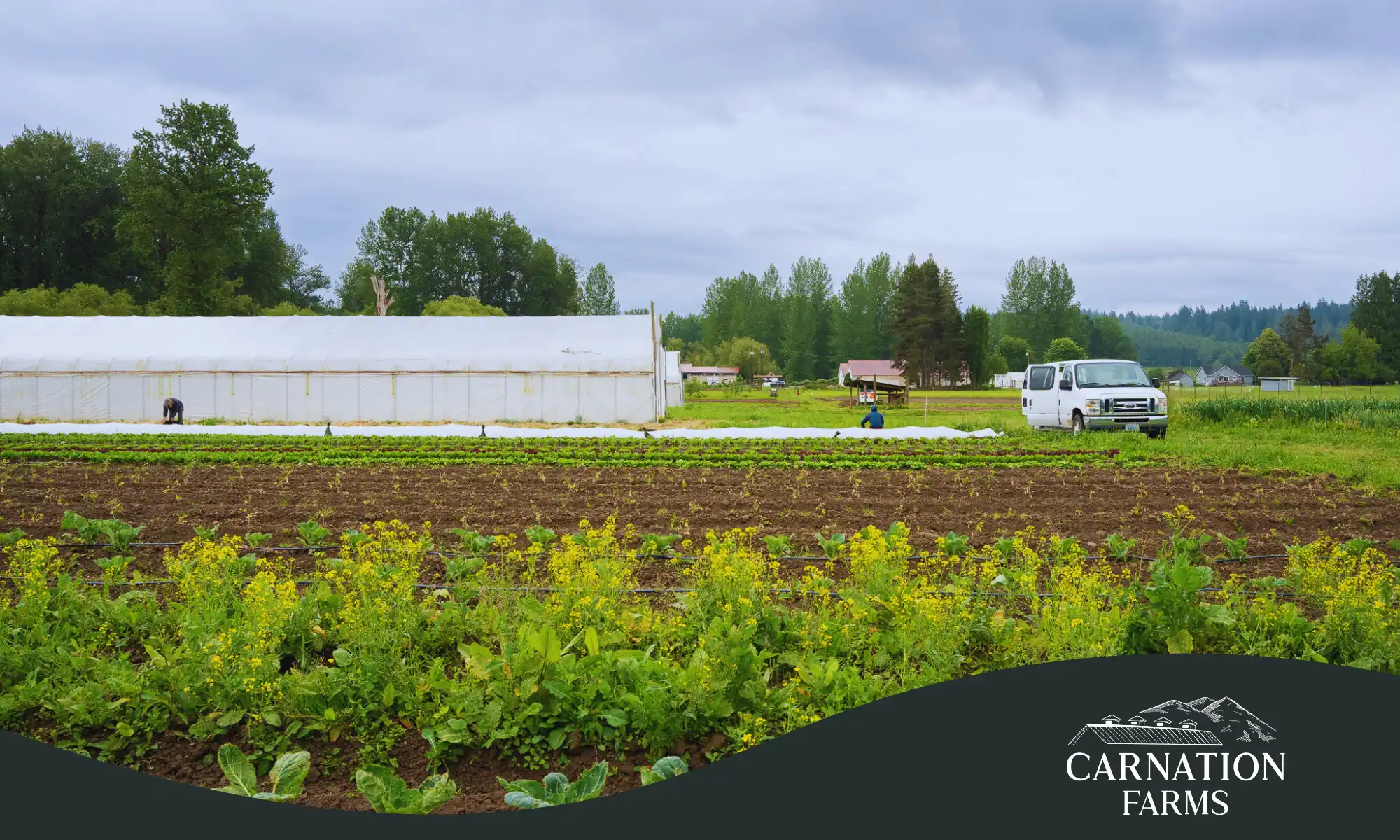
At Carnation Farms, regeneration starts beneath our feet. Our foundational goals: biodiversity, adaptability, and resilience, are built on living soil health that can be stewarded for generations. Across our acreage, diverse rotations integrate vegetables, livestock, and cover cropping, while habitat for pollinators and wildlife expands on-farm biodiversity. Central to our work is humus content, which is the dark, stable fraction of soil organic matter that keeps nutrients cycling, prevents erosion during floods, holds moisture during droughts, and supports more nutrient-dense food for our community.
Our 2024 Impact Report explores how an Adaptive Farming mindset guides practice at the individual field level. In 2024, we tested and compared tools (select tillage, rest periods, fallow, haying, mowing, and Rotational Grazing) to learn what actually builds long-term organic matter here.
Key Takeaways
• Humus Content drives long-term Soil Health and Carbon Sequestration.
• Adaptive Farming beats one-size-fits-all.
• Cover Cropping and Rotational Grazing build stable organic matter.
• Biodiversity reduces inputs and boosts resilience.
Where the Past Feeds the Future
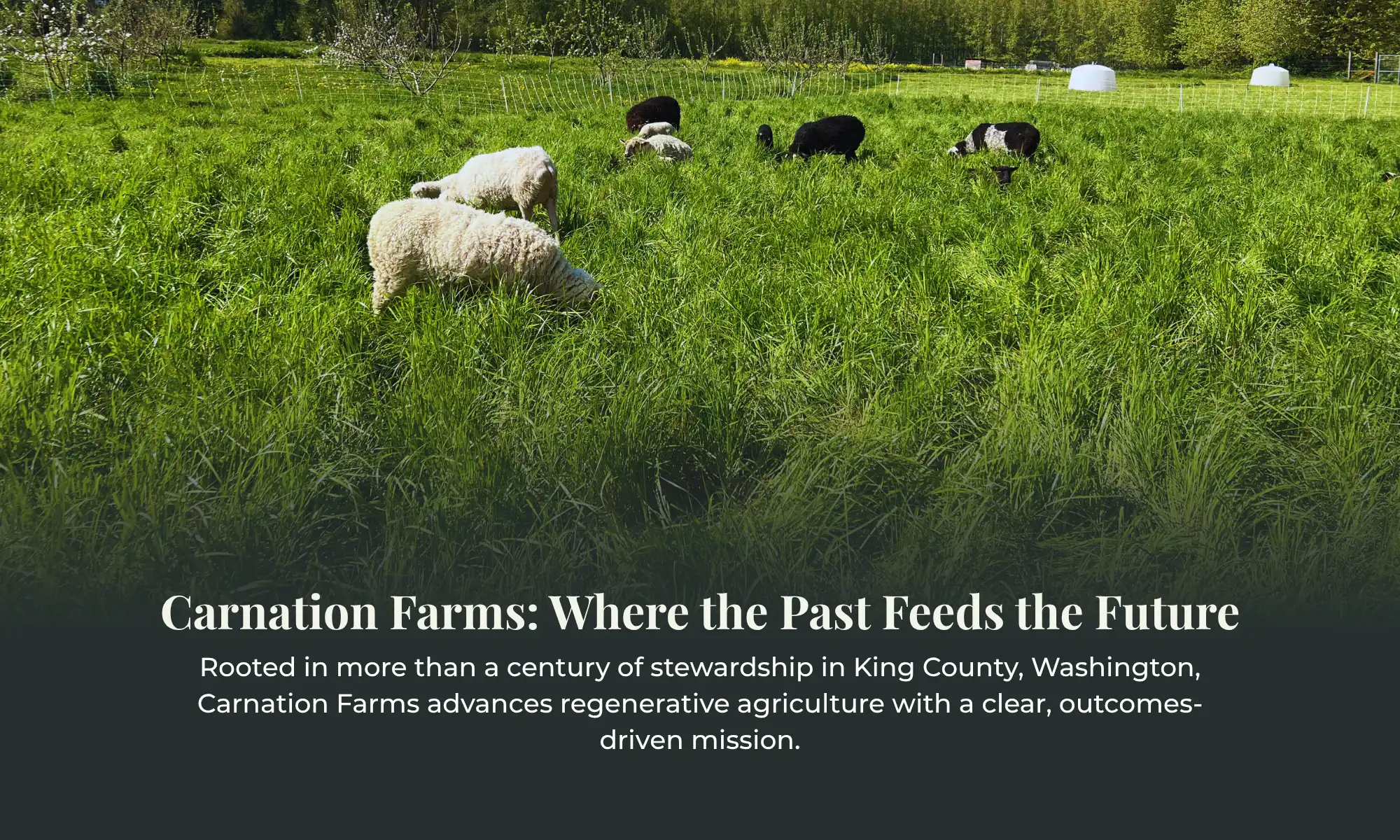
Sheep graze on lush pasture at Carnation Farms, reflecting a century of stewardship and regenerative farming.
Rooted in more than a century of stewardship in King County, Washington, Carnation Farms advances regenerative agriculture with a clear, outcomes-driven mission. Our work connects history to innovation by improving soil health, integrating livestock with the landscape, and building a resilient food system that benefits people and the ecosystem.
Carnation Farms’ Regenerative Mission
Carnation Farms is a historically significant agricultural hub now focused on regenerative agriculture across fields, pastures, and waterways. In 2024 we aligned programs and businesses into one holistic mission to advance a regenerative food system measured by on-farm results and community impact.
Defining Regeneration
For us, regeneration is about relationships among soil and plants, livestock and landscape, and farmers and eaters. This relationship-centered approach guides how we grow food, integrate animals, and share results with our community.
Our Adaptive Approach
We practice Adaptive Farming by testing methods field by field, tracking soil metrics, and refining what works in our local context. This first Impact Report summarizes goals, practices, and measured outcomes from 2023 to 2024, creating a reliable baseline to guide future decisions.
“Our mission is to leave the land better than we found it.” – Eric Popp
Our Director of Regenerative Agriculture emphasizes learning by doing, pairing practices, observing, and iterating, and invites neighbors and partners to participate in the movement.
The Foundation of Health: Humus and Carbon Sequestration
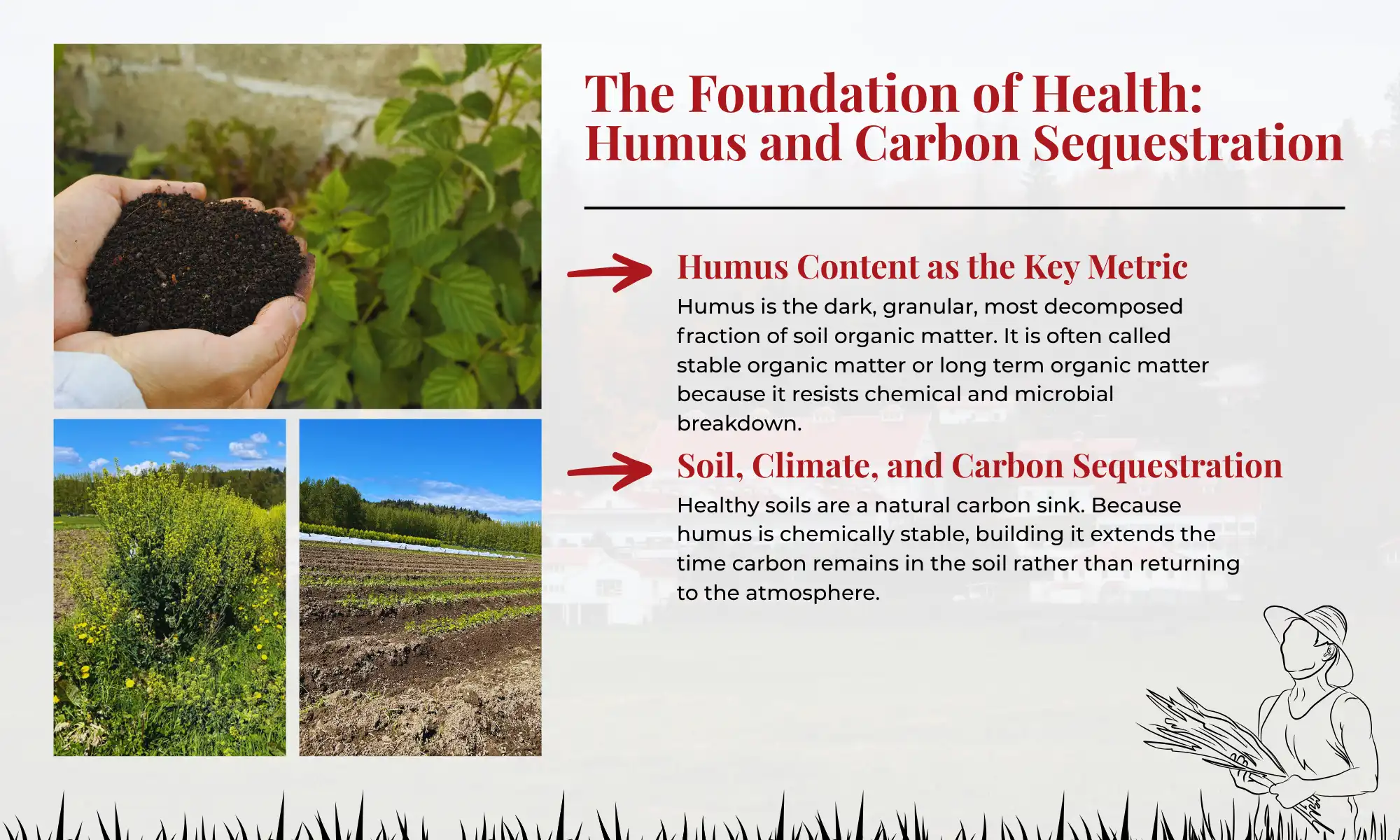
Humus-rich soil and regenerative field practices at Carnation Farms highlight how carbon is stored and soil health improves.
Core Regeneration Goals
At Carnation Farms, our regeneration work is anchored in biodiversity, adaptability, and resilience. These goals come to life through living Soil Health that can be farmed for generations without depleting the resource base. We design diverse rotations that weave together vegetables, perennial forages, and cover cropping, and we integrate ruminants through thoughtful rotational grazing.
This living system improves structure, increases water infiltration, and supports beneficial soil biology that powers nutrient cycling. The outcome is a more resilient landscape, reduced reliance on external inputs, and a stronger foundation for regenerative agriculture in the Pacific Northwest.
Humus Content as the Key Metric
What is humus?
Humus is the dark, granular, most decomposed fraction of soil organic matter. It is often called stable organic matter or long term organic matter because it resists chemical and microbial breakdown. In practical terms, humus is where soils store carbon in the long run. It binds with minerals to form stable aggregates, creates pore space for air and water, and provides a long lasting pantry of nutrients for crops and forage.
Why it matters
Higher humus content boosts climate resilience and productivity. In Washington’s wet weather, humus rich soils protect fields from erosion by improving structure and keeping soil in place. In dry spells, humus acts like a sponge that holds moisture and makes water available to roots. This stability improves nutrient availability, supports balanced plant growth, and leads to more nutrient dense food. Healthier soils also reduce the need for synthetic fertilizers, which helps protect waterways and lowers production risk for farmers.
Soil, Climate, and Carbon Sequestration
Healthy soils are a natural carbon sink. Because humus is chemically stable, building it extends the time carbon remains in the soil rather than returning to the atmosphere. That is why we treat humus content as a practical proxy for on farm carbon sequestration. By tracking humus year over year and pairing it with field level practices such as cover cropping, rest periods, and rotational grazing, we can see which combinations most effectively lock carbon in place while improving Soil Health.
Practices Driving Soil Health Outcomes (Data Deep Dive)
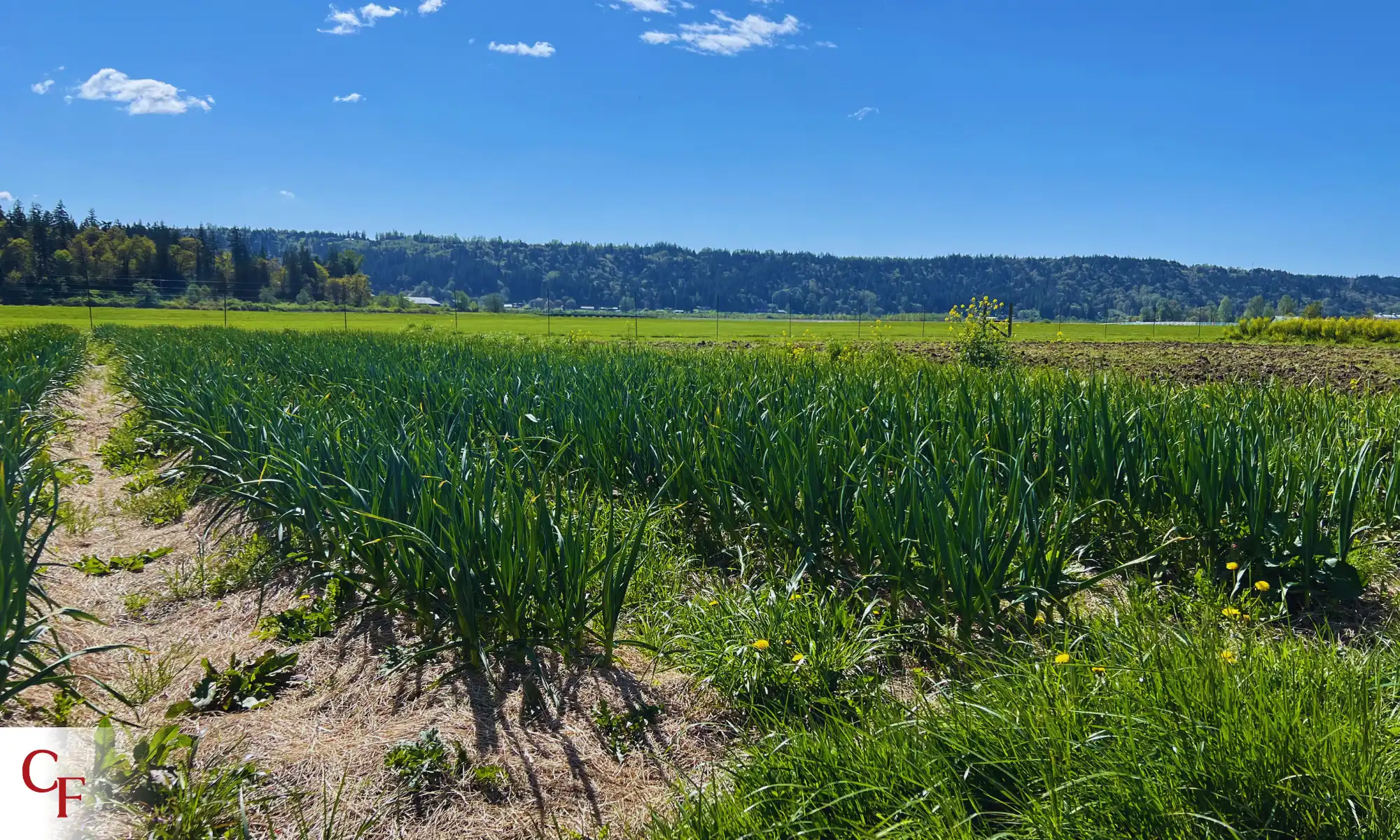
Regenerative field trials at Carnation Farms show how adaptive practices influence long-term soil health outcomes.
Adaptive Soil Management through Experimentation
Carnation Farms uses a field-by-field, data-led approach to improve humus content and long-term soil health. In 2023 and 2024 the team sampled 18 fields on a consistent annual schedule to establish a baseline for long-term organic matter and to compare practice combinations at the field scale. Management varied intentionally by plot, including low or no tilling, periods of rest and fallow, cover cropping, haying, mowing, and rotational grazing. Results were then evaluated against humus changes to identify what worked best under local conditions.
The Tillage Surprise: Context Beats Dogma
No‑till is not a silver bullet.
- Field A4: Despite low tillage, poor cover‑crop establishment led to a 15% humus decrease (3.9% → 3.3%).
- Field C5: Heavy till in 2023, followed by rest, cover crops, and rotational grazing, delivered an 18% increase (2.8% → 3.3%).
- Control Field A1: Light till + cover crop + a year of rest with grazing yielded a 46% jump (2.4% → 3.5%)—a major single‑year increase for stable organic matter.
Livestock Integration and Rotational Grazing
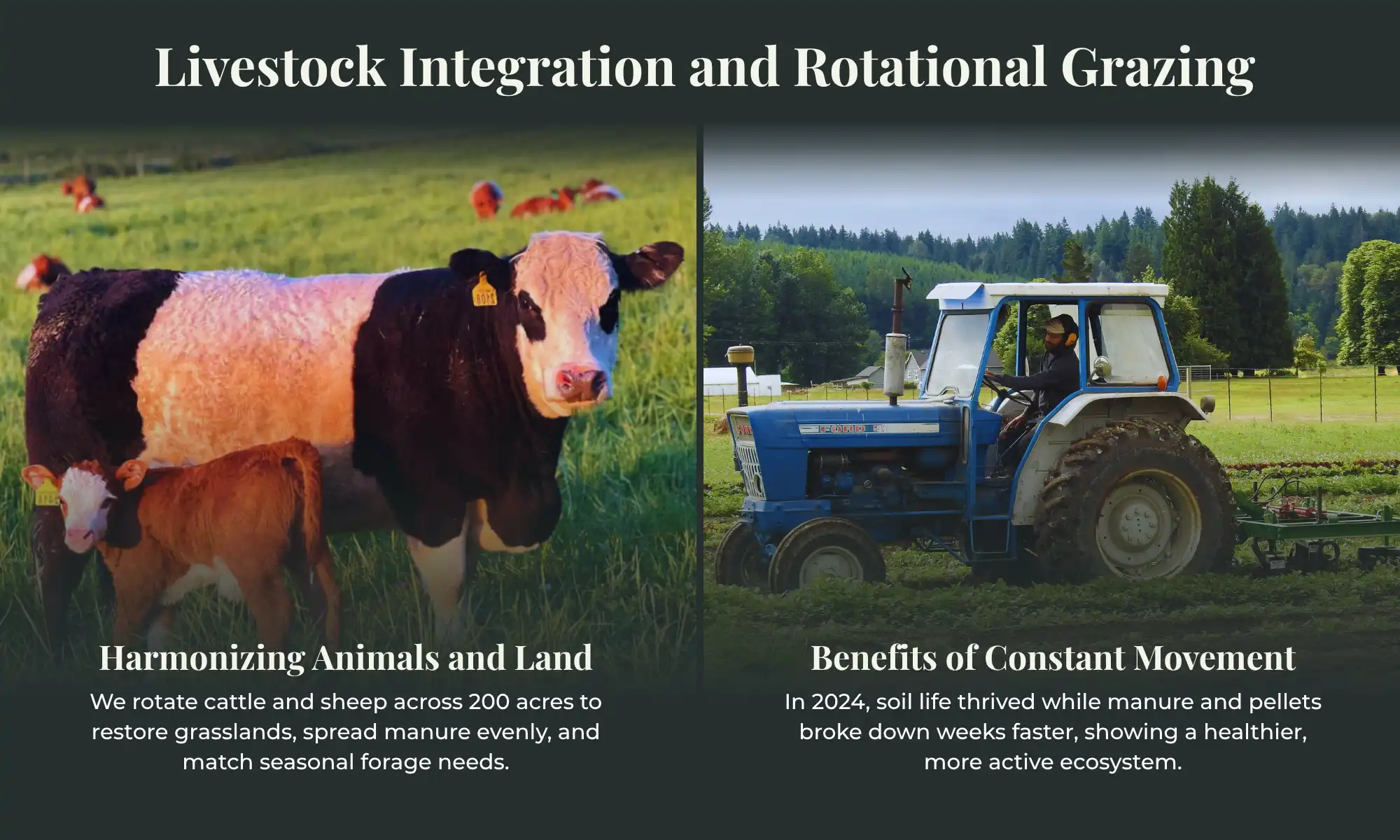
Carnation Farms shows how cattle, sheep, and rotational grazing work together to restore soils and strengthen ecosystem health.
Harmonizing Animals and Land
We manage cattle and sheep with frequent moves across approximately 200 acres of pasture to support grassland recovery, distribute manure evenly, and protect plant vigor through rest periods. Seasonal adjustments between upland and lowland areas are used to match forage conditions and animal needs.
The Benefits of Constant Movement
Soil biological activity increased notably in 2024. Cattle manure that previously persisted for 45 to 90 days broke down within a few weeks. Sheep pellets that took 30 to 60 days in 2023 disappeared in about two weeks in 2024. These faster decomposition times indicate a more active soil ecosystem.
Haying and Grazing: What the Data Say
- LP1 (hayed only): Humus up 23% (3.1% → 3.8%).
- LP2 (hayed + grazed): Humus up 31% (2.9% → 3.8%), suggesting grazing can help cycle organic matter in hayed fields via manure.
Strategic Livestock Shifts
A 2024 financial review supported a shift away from poultry toward ruminants, based on stronger margins and a dedicated market for cattle and sheep. This decision aligned production with ecological outcomes observed in the pastures and reinforced the farm’s regenerative direction.
Continuous Learning, Measurable Gains
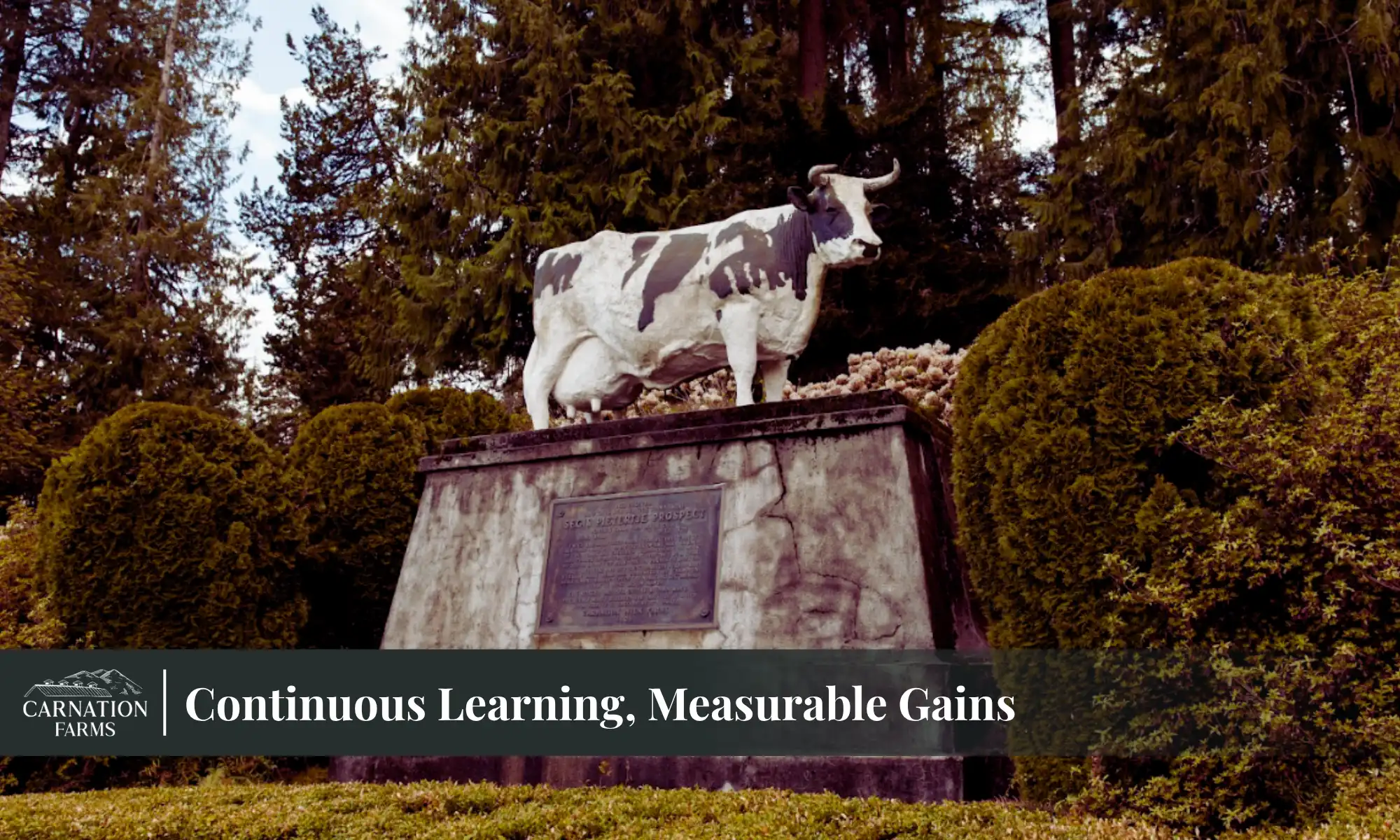
The historic Carnation Farms cow monument symbolizes ongoing learning, soil progress, and regenerative milestones.
Building Soil Health at Carnation Farms is a long game, measured in rising Humus Content, on-farm biodiversity, and whole-system resilience. Our 2023 to 2024 outcomes show that context-aware combinations of Cover Cropping, strategic rest, Rotational Grazing, and right-sized tillage can accelerate Carbon Sequestration while strengthening fertility and water holding capacity. We will continue sampling each September, scaling the practices that deliver the strongest results, and sharing what we learn with peers and our community.
Stay tuned for the next chapter in this series for a deeper look at habitat, waterways, and wildlife: Part 2 — Biodiversity, Community, and the Future of Farming
Plan a visit or taste the results
Join us for upcoming events and workshops, explore more about our regenerative work on our website, and stop by the Farmstand to pick up pasture-raised lamb and beef grown on our regenerating fields.
2024 Impact Report Frequently Asked Questions
1. Why does Carnation Farms track humus instead of only total organic matter?
We focus on Humus Content because humus, the stable and long-term form of organic matter, changes slowly and resists breakdown, making it a more reliable indicator of durable Soil Health and on-farm Carbon Sequestration than fresher residues. As humus levels rise, soils retain water longer, resist erosion, and supply more plant-available nutrients. These outcomes are central to our Regenerative Agriculture approach and long-term sustainability goals.
2. Is tillage always harmful in a regenerative system?
Not always. Our field results show that when tillage is paired with Cover Cropping, adequate rest, and Rotational Grazing, Humus Content can increase significantly. For example, a high-till field that was rested and cover-cropped gained humus year over year, while a low-till field with poor cover-crop establishment lost humus. This demonstrates that context, timing, and adaptive management matter more than strict adherence to a single method.
3. How does rotational grazing improve soil?
Rotational Grazing enhances biological activity by moving animals frequently, which reduces compaction, distributes manure evenly, and supports rapid plant recovery. In 2024 we observed much faster manure decomposition than in 2023. Cattle manure that previously took 45 to 90 days to break down decomposed within weeks, and sheep pellets that lasted 30 to 60 days disappeared in about two weeks. These changes indicate a more active soil ecosystem and stronger overall Soil Health.
4. What changed the most from 2023 to 2024?
Across 18 sampled fields, eight increased humus, three decreased, and seven remained stable. Standout gains included A1 (+46%), C5 (+18%), LP1 (+23%), and LP2 (+31%). These results highlight the benefits of combining Cover Cropping, rest, haying, and Rotational Grazing to enhance long-term Soil Health and demonstrate measurable progress in Regenerative Agriculture practices at Carnation Farms.
5. How can I see these practices in action?
Visit our Farmstand, join a workshop, or explore on‑farm dinners to experience outcomes of Regenerative Agriculture first hand. Each visit offers a glimpse into how our practices like cover cropping, rotational grazing, and soil health monitoring work together to build a more resilient and sustainable food system.
Recent Posts

 February 24, 2026
Best Snoqualmie Valley Meat Options in Washington